 Seattle Streets Alliance
The problem
The Ballard Bridge is the only street crossing of the Ship Canal between Fremont and the Locks. Its sidewalks are too narrow for people to pass safely, and the connections at each end are dangerous. Ballard-Fremont Greenways is working to make the bridge safe, comfortable, connected and convenient for people of all ages and abilities.
What people told us
In 2025 and 2026, Ballard-Fremont Greenways surveyed 423 people who walk, bike or roll across the Ship Canal, or would like to.
- 97% feel unsafe crossing the Ballard Bridge on foot or by bike.
- 60% would use the bridge at least weekly if it were safer.
Many people shared their own stories. Here are a few of them:
- "I used to ride this daily as it was the fastest way to pick up my son from childcare. It was always terrifying."
- "Our friend’s dog was running at run club, there was a bike coming from the other direction on the sidewalk so the dog jumped over the curb and [got] hit by a car… We care more about cars than we do about living beings."
- "I enjoy crossing every bridge in Seattle as a pedestrian except this one."
History
- 1917: The bridge opens alongside the new Ship Canal. Streetcars begin crossing it in 1918.
- 1940: The wooden approaches are rebuilt in concrete and steel. The rebuilt bridge reopens without streetcar tracks.
- 1991 and 2008: Fatal crashes on the bridge lead neighbors and advocates to call for safety fixes.
- 2014 to 2020: SDOT studies sidewalk widening (2014), safety fixes (2018) and the long-term future of the bridge (2020). Little is built.
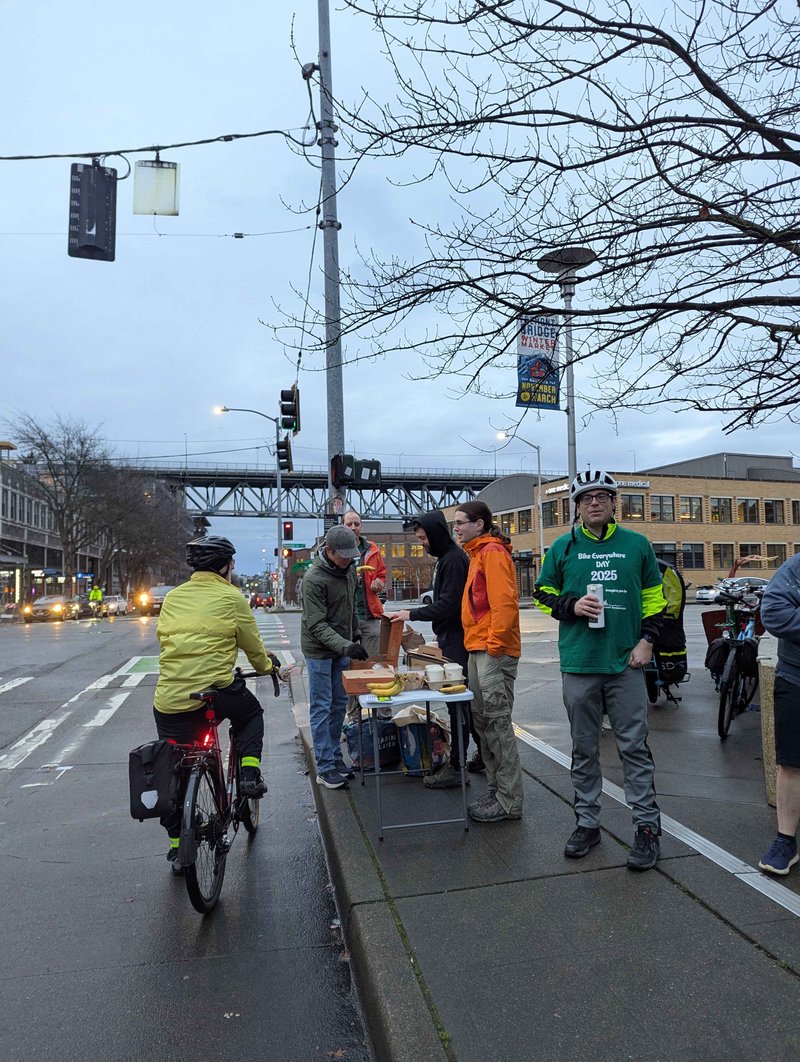
- 2025 to 2026: Ballard-Fremont Greenways surveys 423 people about the bridge and holds four bridge cleanups.
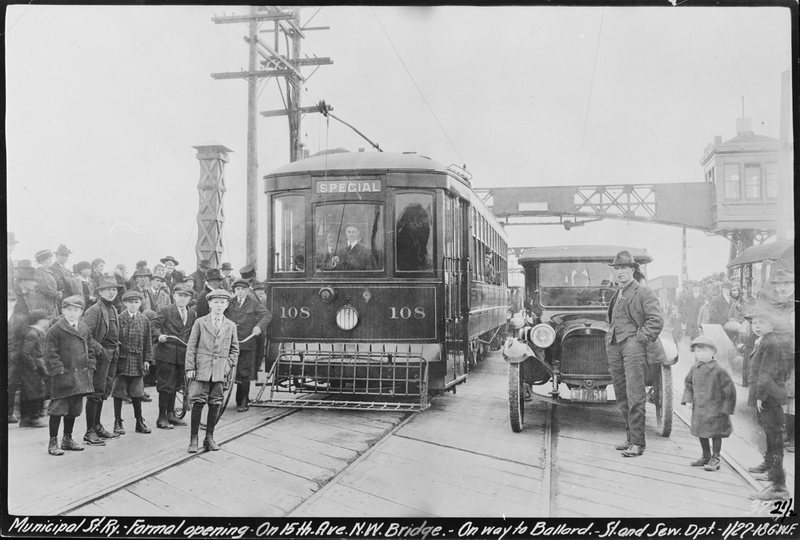
Opening of streetcar service on the Ballard Bridge, 1918.
The walkway
History
- The sidewalks on each side are about 3.5 feet wide, with a low curb between them and traffic. People walking and biking share them in both directions.
- 2014: An SDOT study found widening the sidewalks was feasible, at $3 million to $48 million depending on the option. It was not funded.
- 2020: The Ballard Bridge Planning Study compared rehabilitating the bridge, including adding a shared-use path, with replacing it. No option was chosen or funded.
- 2026: SDOT began designing a wider sidewalk on the west side as part of a levy-funded repair project. The repairs are funded. The wider sidewalk is not.
What we are asking for
The City has proposed about $15 million through 2030 for structural repairs on the bridge, "including potential pedestrian improvements." We are asking the City to:
- Fund and build the west-side shared-use path as part of the repair project, not after it.
- Separate the path from traffic and make it wide enough for people walking and biking in both directions.
- Start the Ship Canal Pedestrian-Bicycle Crossing Study in the Seattle Transportation Plan, so there is enough room to cross the canal as more people bike.
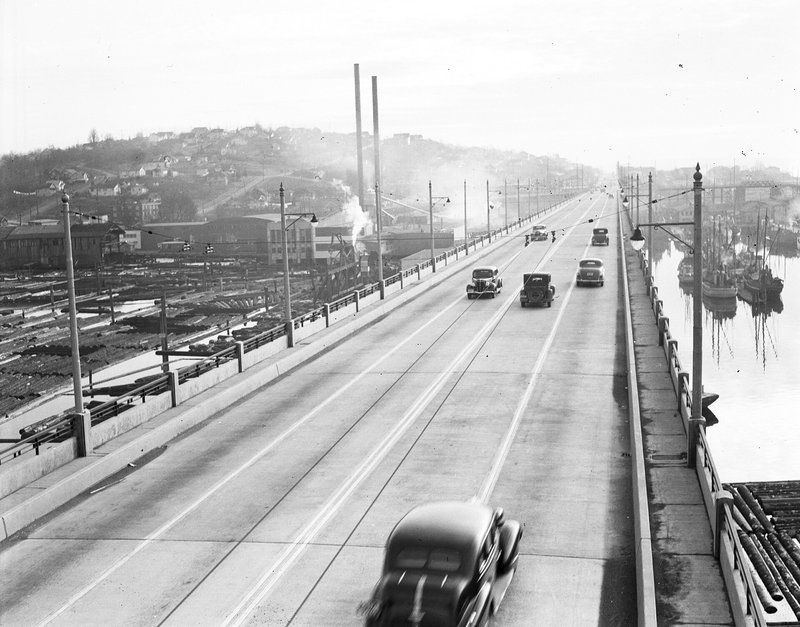
Looking south across the Ballard Bridge, 1941.
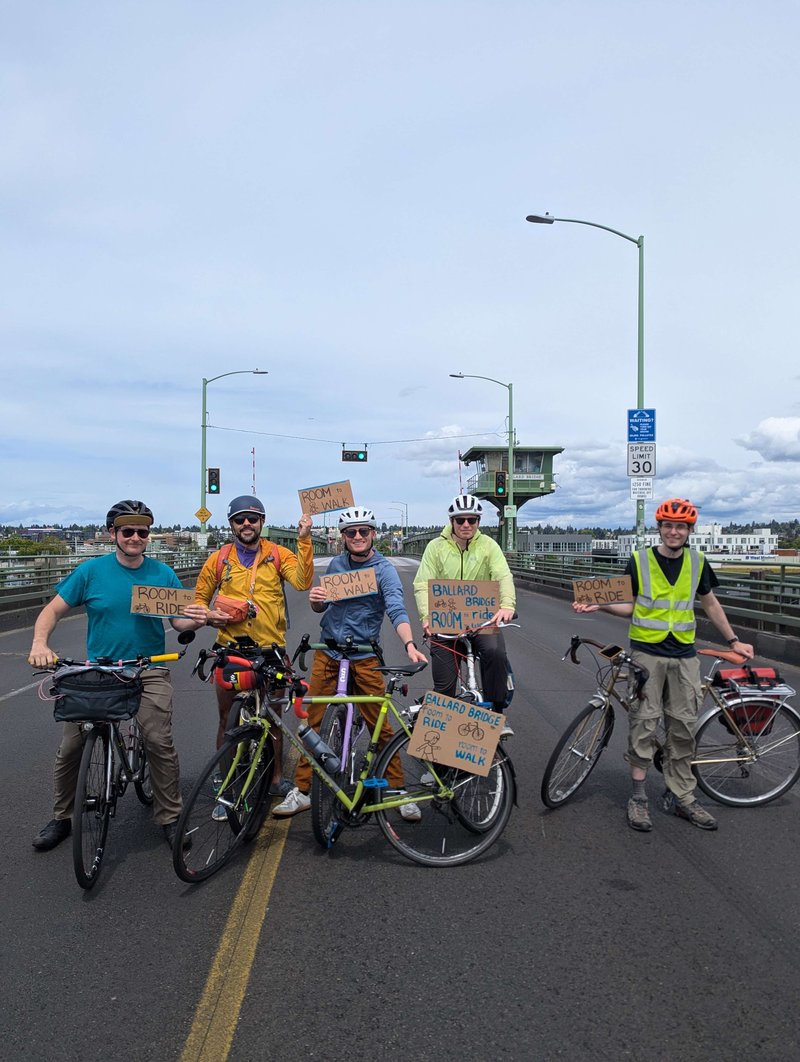
Volunteers on the bridge during a 2025 closure to cars.
The south end (Merge of Death)
History
- Heading south, people on bikes leave the sidewalk through a narrow curb cut and merge into fast traffic on 15th Ave W. People walking have to use stairs under the bridge. There is no connection to the Ship Canal Trail.
- 2009: SDOT reviewed fixes but called them too expensive, and added signs and paint instead.
- 2018: SDOT estimated a $1.0 to $1.3 million fix, including a new crossing and a shared-use path. It was not built.
- 2026: A state budget request to add a traffic signal and connect the intersection to a future walkway on the bridge was not funded.
What we are asking for
- State funding in the 2027 legislative session for a signalized intersection at 15th Ave W and W Emerson St.
- A safe connection from the bridge to the South Ship Canal Trail.
- Designing the south end together with the west-side path, so the two connect.
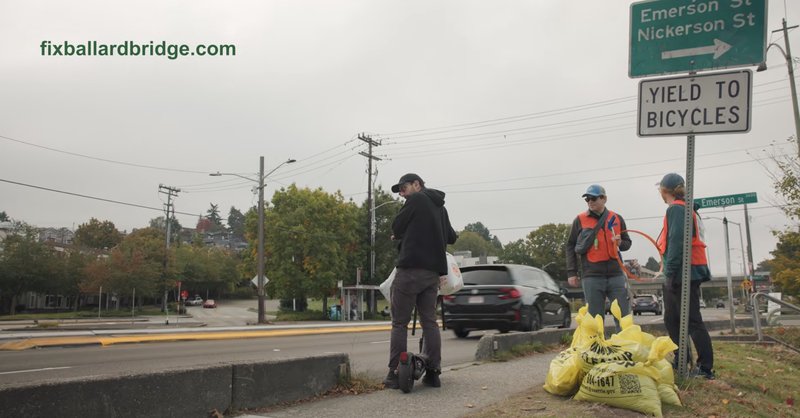
The merge of death, featuring the infamous sign "Yield To Bicycles".
Get involved
- Come to a Ballard-Fremont Greenways meeting to learn more.
- There will be several opportunities to support infrastructure improvements during the 2027 legislative session.
Sources
- SDOT: Ballard Bridge Rehabilitation Project
- SDOT: Ballard Bridge Planning Study (2020)
- City of Seattle: 2027-2032 Proposed Capital Improvement Program, SDOT (project MC-TR-C129)
- Connect Ballard: Ballard Bridge Safety Recommendations (2015)
- HistoryLink: Ballard Bridge (Seattle)
Historic photos: Seattle Municipal Archives, CC BY 2.0.